Common Terms of the California Missions
Many words and phrases used during the California mission era are still in use . These include architectural and military terms, religious words and phrases, Native American terms and place names, and of course, the Spanish words for many aspects of everyday life. This glossary provides a handy single reference of these California Mission terms.
- Adobe
-
Sun-dried bricks made of clay mixed with straw and sometimes horse manure, then baked in the sun. Also refers to structures made of this material.
- Aguardiete
-
A term derived from the Latin aqua ardens, which means fiery water. In the mission era aguardiete meant distilled spirits made from the wine of the Mission Grape.
- Alcade
-
In Spain, a local magistrate. In Alta California, the neophytes appointed to assist the padres in keeping order, reinforcing the rules of the mission and settling minor disputes. They functioned more as policemen than judges.
- Alferez
-
Lowest rank of a commissioned officer in the Spanish Army, equivalent in rank to an ensign or second lieutenant.
- Almud
-
A unit of dry measure representing about 4.2 quarts. It was 1/12 of a fanega.
- Alpechin
-
The mixture of oil and water after pressing olives for oil.
- Alta
-
Spanish for upper. Used in Alta California, the Spanish territory that included present day California.
- Alta California
-
The Spanish territory including present day California
- Americano
-
Citizen or resident of the United States. The first Americans to visit Alta California were seamen, followed later by the pathfinders and mountain men who opened up the West.
- Antap
-
A Chumash religious cult, keepers of sacred knowledge.
- Apostolic College
-
Franciscan institutions established to receive and train priests for service in the missions. The missions of Alta California were sponsored by the College of San Fernando founded in 1734 in Mexico City.
- Apse
-
A domed or vaulted semicircular recess, found most frequently at the east end of a church.
- Arroyo
-
A brook rivulet or small stream.
- Asistencia
-
A sub-mission having residents, converted Indians, but no resident missionary.
- Asphaltum
-
Naturally occurring gluey tar used by the Chumash for waterproofing canoes and baskets.
- Atole
-
A maize (cornmeal) gruel or porridge.
b - Baja
-
Spanish for lower. Used to decribe Baja California, the peninsula that is part of Mexico, directly south of Alta California.
- Balustrade
-
A low barrier (made of carved and painted wooden spindles and a railing) often created in the mission churches.
- Baroque
-
17th century style of artistic expression characterized by elaborate ornamentation and dynamic forms.
- Barranca
-
A deep ravine or canyon.
- Basilica
-
A Roman Catholic Church of special historical and religious importance.
- Bear Flag Revolt
-
The armed uprising by a band of Americans that started on June 14, 1846, leading to the declaration of the independent California Republic. Within a month, the United States occupied Monterey and California officially became part of the United States in 1848 with the Treaty of Guadalupe Hidalgo.
- Bee-hive oven
-
A wood-fired cone-shaped over used for baking bread.
- Bodega
-
A cellar, wine cellar or wine vault.
- Bota
-
A leather container consisting of a single cowhide used for storing or shipping tallow. The contents weighed about 200 pounds.
- Bulto
-
A carved, painted three-dimensional figure usually set in a recess. Most of the mission churches featured a bulto depicting the saint for whom the mission is named.
- Buttresses
-
Supporting structures built into a standing wall to strengthen it.
c - Caballero
-
Man on horseback.
- Cabo
-
Corporal
- Californios
-
Native-born Californians of full or partial Hispanic heritage.
- Calinche
-
A drink made from the fruit of the prickly pear or tuna cactus.
- Campanario
-
Bell tower. Can be free standing or attached.
- Campo Santo
-
Literally means “Holy Field.” The cemetery.
- Canaliño
-
A name used by European explorers and settlers to identify Chumash peoples who lived in the Santa Barbara Channel area. The word is also used today by some researchers to refer to the group of Native Americans who lived in the Channel area thousands of years ago and who are probably ancestors of the Chumash.
- Candeleros
-
Candlesticks in Spanish.
- Cañón
-
Spanish for Canyon
- Cantor
-
A singer in church services, which was often a neophyte Indian.
- Capilla
-
A chapel.
- Carreta
-
Wooden, two-wheeled cart, pulled by oxen. The cart was the principal mode of transporting items in Alta California.
- Casa-reales
-
Government buildings, town hall.
- Castas
-
People of mixed blood, as opposed to Spanish and Indians.
- Cemetery
-
The formal burial grounds for the remains of the dead. Most of the mission cemeteries were sited adjacent to the mission church.
- Cenotaph
-
A monument erected to honor someone whose mortal remains are elsewhere.
- Cenotaph
-
A monument built to honor people whose remains are buried elsewhere elsewhere.
- Chancel
-
The area in a church containing the altar and seats for the clergy.
- Channel Indians
-
The natives living in the Santa Barbara area.
- Cocinero
-
A cook, probably for the priest, since this was normally not a normal male occupation within the Indian population.
- Colaterales
-
The side altars in a church.
- Comissionado
-
A deputy or commissioner. As normally used in California, he was a non-commissioned officer serving on detached duty as a magistrate of a pueblo or villa.
- Commandante
-
Military commander.
- Commissary Prefect
-
An office established in California in 1812 to assist the Father President in the supervision of missionaries and liaison with the territorial government.
- Compound
-
A cluster of connected buildings. Most missions were built as a quadrangle including a church, padre’s quarters and workshops, with native quarters, warehouses and other buildings surrounding the central compound.
- Convento
-
The padre’s residence in the mission complex.
- Corridor
-
A long walkway or gallery around the inner patio. These were usually arched or colonnaded.
- Crioles
-
Spaniards born in the New World.
- Cuera
-
Protective several-ply leather jacket, usually sleeveless and of thigh length.
- Cupola
-
A small rounded structure built on top of a roof or bell tower.
d - Dado
-
Decorative border appearing on the lower portion of the interior wall of a church.
- Diputacion
-
Elected assembly, which met at Monterey during the Mexican rule of Alta California.
e - El Camino Real
-
Technically, the “Royal Highway” a term used to designate the main road in a Spanish territory. In Alta California, El Camino Real was a dirt road that linked the missions and extended from San Diego to Sonoma. U.S. 101 roughly parallels El Camino Real.
Synonyms: Royal Highway - Enfermero
-
An Indian male nurse who tended the numerous sick at the mission.
- Enramada
-
Temporary brush shelter.
- Entrada
-
Entrance.
- Escolta
-
The military guard assigned from a nearby presidio for mission or pueblo protection. It consisted of a corporal and from 5 to 7 soldiers.
- Escopeta
-
A short carbine carried by most Spanish soldiers.
- Espadana
-
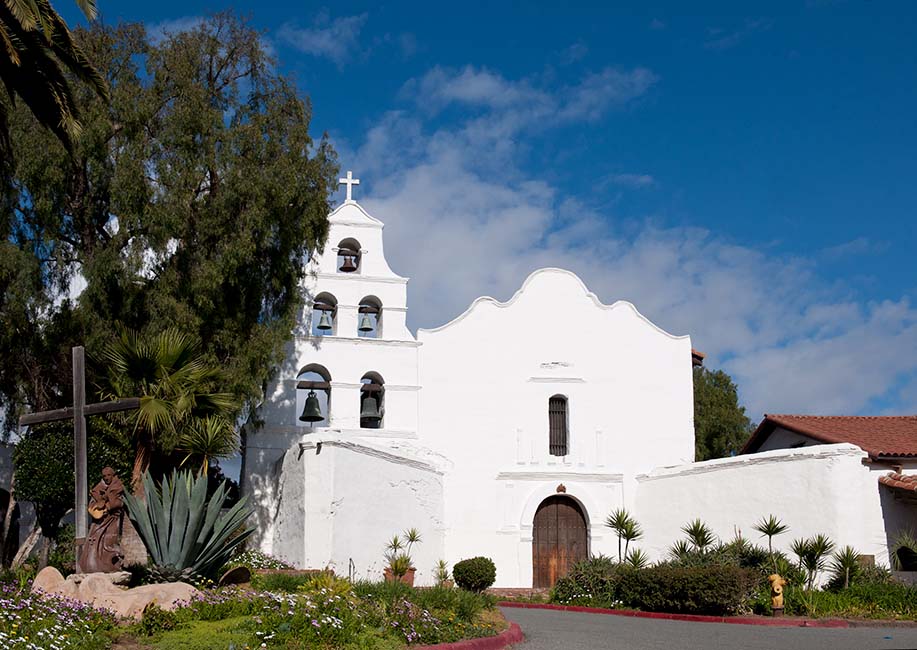
Separate pierced bell-wall such as that found at Mission San Diego or Mission San Gabriel.
- Estadal
-
Spanish linear measurement of about 3.3 meters, or 11 feet.
f - Fanaga
-
A Spanish measure equal to 100 pounds.
- Fandango
-
Lively regional Spanish dance and its music.
- Fanega
-
A fanega is approximately 1.575 bushels. For Spanish measurement it is also 12 almundes.
Synonyms: fanegas - Fiesta
-
A gathering of people to celebrate an event, such as a Saint’s Day, the anniversary of the mission etc. The Chumash also held fiestas before the arrival of the Europeans. During Chumash fiestas people traded goods and played games, and the village leaders conducted business.
- Founders
-
Padres and principal Spanish authorities that first settled Alta California and established the missions.
- Franciscan
-
Member of the Catholic religious order founded by Saint Francis of Assisi in 1209. Franciscans are dedicated to preaching, missionary work and charitable acts.
- Fray
-
Member of a mendicant (begging) order, such as the Franciscans. Could be a priest or lay brother. Should only be used with the man’s full name, not with the surname. (Jesuits were not frays.)
- Fresco
-
A painting laid down on moist lime plaster with color pigments suspended in a liquid medium.
- Frigate
-
In mission days a frigate was a three-masted sailing ship. In most navies, a frigate is the smallest surface combatant that can conduct extended blue-water missions. The raid on Alta California in 1818 was led by frigate, La Argentina, a 677-ton vessel outfitted with 34 eight- and 12-caliber guns, and carrying a crew of about 260 men.
g - Gente de Razon
-
Literally, educated people. A phrase used to characterize those who followed Spanish customs. Used to designate non-Indians.
- Governor
-
The senior official appointed to administer an area. California was initially governed from Loreto, Mexico, but the seat of government moved to Monterey in 1777. During the Mexican period the seat of government shifted several times as northern and southern factions vied for control.
h - Habit
-
Garb worn by members of a religious community or order. In Alta California the Franciscans wore a gray habit.
- Hidalgo
-
Member of Spain’s lowest-ranking nobility.
i - Informe
-
A general term which refers to the annual report of the state of a mission district.
- Inglesia
-
Church.
j - Jacal
-
A hut or crude dwelling often made of brush and hides.
l - Ladrillo
-
A tile floor.
- Lagar
-
A wine, olive, or apple press.
- Lavanderia
-
Laundry.
- Legua
-
Standard Spanish measure of distance for a league, equal to 2.597 miles. There were 5,000 varas in a legua.
- Letter of Marque
-
The papers given a privateer authorizing him to act. The letter specified the period for which it was valid. Often the limits of the Marque were vague, leaving it up to the captain and crew to determine where to go and what they could seize.
m - Madrina
-
Godmother
- Mayordomo
-
A mayordomo served as a custodian of civic property, also a foreman of a hacienda or mission. An overseer.
- Mendicant Order
-
Religious organizations which have renounced all common and personal property. Thus, members are dependent upon begging in order to survive.
- Merced de Tierra
-
Land grant.
- Mestizo
-
Mixed-blood of European and Indian ancestry.
- Metate
-
A flat slab of rock used to grind seeds, nuts and plant foods into flour.
- Mexican-American War
-
Armed conflict between the United States and Mexico that lasted from 1846 to 1848. Led to annexation of 58 percent of Mexican territory including Texas, New Mexico, Arizona and California.
- Michumash
-
The word from which the term Chumash originated. It refers to those people who lived on Santa Cruz Island.
- Milpa
-
A plot of land, grain field, or corn field.
- Mission Vieja
-
Literally means Old Mission. This is the term used for the first site of Mission La Purísima Concepcíon which was destroyed by the earthquake of 1812.
Synonyms: Old Mission - Missionary College
-
Franciscan institutions established to receive and train priests for service in the missions. The missions of Alta California were sponsored by the College of San Fernando founded in 1734 in Mexico City.
- Molino
-
A grist-mill.
- Monjerio
-
Woman’s quarters.
n - Native Americans
-
The indigenous people living in a land. The Indian natives of Alta California lived in the area for several thousand years before the arrival of the Europeans.
- Nave
-
The principal interior of a church, where the congregation worships.
- Neophtes
-
Indians who were converted to Christianity and then lived at a mission.
- New Spain
-
Present day Mexico, with its headquarters in Mexico City.
Synonyms: Mexico - Nicho
-
A recess designed to hold a statue. Can be free standing, or part of a reredo.
- Novitiate
-
Religious house where beginners (novices) are trained before taking permanent vows.
p - Padre
-
A Roman Catholic priest.
- Padrino
-
Godfather.
- Padrón
-
A mission register of neophyte families which was like a census.
- Paje
-
An Indian house-servant for the mission fathers
Synonyms: Page - Panadero
-
A baker or bread-maker.
- Paqwot
-
Chumash term referring to the leader of several villages.
- Pathfinder
-
An early explorer who established trails in un-charted territory.
- Plaza
-
A rectangular central public area. All of the Spanish pueblos (towns) and most of the missions included a plaza.
- Poblador
-
Original Hispanic settler.
- Polychrome
-
Decorated with several colors.
- Portal
-
A gate or doorway.
- Pozole
-
A porridge or thick soup of wheat, corn, beans or horse beans and meat.
- President
-
Chief Religious Official in the mission territory, appointed by the apostolic college of which he was a member. After 1812, some of the responsibilities were taken over by a Commisary Prefect.
Synonyms: Mission President - Presidio
-
Fortified military outpost or fort. The Spanish presidios in Alta California included barracks, workshops, stables and a chapel.
- Privateer
-
A privately owned vessel armed and equipped at the owner’s expense, for the purpose of carrying on a maritime war by the authority of one of the belligerent parties. The privateer was authorized to appropriate captured property. The men who sailed on one of the vessels were also called privateers.
- Procurator
-
Friar appointed to take care of business matters. The procurator of San Fernando College purchased supplies for the California missions.
- Pueblo
-
The non-Indian towns established to help colonize Alta California.
- Pulpit
-
Raised platform in a church used for preaching. The sounding board or canopy over the pulpit is called the tornavoz in Spanish.
- Pulpito
-
Spanish for Puppit, a raised platform in a church used for preaching. The sounding board or canopy over the pulpit is called the tornavoz in Spanish.
q - Quadrangle
-
Four-sided enclosure. Most missions were laid out using a quadrangle design.
r - Ranchería
-
An Indian settlement where dwellings are not permanent and are scattered some distance from each other.
- Rancho
-
A settlement or a ranch. During mission times ranches could be used for livestock or for agriculture and typically included vast holdings of land.
- Rectory
-
Clergy’s residence.
- Refectory
-
The dining area in a mission.
- Reliquary
-
Sealed metal and glass receptacle for displaying sacred objects.
- Remate
-
The front wall of a mission church, similar to an espadana, but without openings for bells. It may contain a niche for a statue.
- Reredos
-
Structure placed behind the altar table and against the wall, typically sub-divided into panels and nichos, and richly decorated.
- Restoration
-
The process of rebuilding a structure, using to the extent possible, original plans, material and tools.
- Runaways
-
Neophytes who escaped from a mission. A concerted effort was made to recapture all runaways, often with military excursions into the interior during the 1820s-1830s, when missions were under pressure to maintain production as the neophyte population declined.
s - Sacristan
-
An individual having charge of the sacristy of the church.
- Sacristy
-
Room off the sanctuary containing priest garments and other articles used in church services.
- Sala
-
Formal reception room; an area in the mission used to receive guests and visitors.
- Sanctuary
-
Part of the church containing the altar.
- Sangrario
-
Spanish for Tabernacle, an ornamental receptacle placed in the center of the altar and used to hold consecrated wafers.
- Scurvy
-
A condition resulting from a lack of ascorbic acid (Vitamin C). Common among sailors due to an inadequate intake of fresh fruits and vegetables. Many of the sailors on the Portola expedition of 1769 died of scurvy.
- Secularization
-
The process under which the Mexican government removed the mission lands from the jurisdiction of the Franciscans (who were replaced by secular priests) and half the mission land theoretically turned over to the Indians. The bylaws for secularization were enacted by the Mexican Congress in 1828, ratified in 1833 and fully enforced in 1834.
- Shaman
-
Medicine man responsible in an Indian tribe for curing disease and contacting the spiritual world.
- Siliyik
-
A Chumash sacred area found within a village
- Soldados de Cuera
-
The term used to describe the Spanish soldiers, named after their distinctive reinforced leather jacket. According to regulations, the jackets were to be made out of seven layers of buckskin, and were designed to stop an Indian arrow.
t - Tabernacle
-
Ornamental receptacle placed in the center of the altar and used to hold consecrated wafers.
- Tasajo
-
Spanish term for jerked beef which was used extensively at the missions.
- Temescal
-
Spanish word for an Indian sweathouse, used exclusively by men for both religious and non-religious purposes.
Synonyms: sweathouse - Temporarilities
-
Matters pertaining to the non-religious aspects of the mission: Feeding, clothing and housing of the Indians; development of agriculture; teaching of trades and skills.
- Testigo
-
A wedding witness.
- Third Order of St. Francis
-
Organization of lay people who emulate and follow the teachings of St. Francis, but who do not give up marriage or worldly possessions.
- Tile
-
The tiles used at the mission were made on the premises from clay shaped over log molds, and then fired in a kiln.
- Tok
-
Milkweed fiber used to make strings for a bow.
- Tomol
-
Plank canoe made by the Chumash Indians.
- Transept
-
That part of a cruciform church that crosses at right angles between the nave and the apse.
- Treaty of Guadelupe Hidalgo
-
The 1848 agreement between Mexico and the United States that ended the Mexican War, and ceded 58 percent of Mexican territory, including Alta California, to the United States.
- Tribe
-
A society consisting of several communities united by kinship, culture, language and other social institutions.
v - Vaquero
-
Cowboy, cattle hand.
- Vara
-
Spanish yard of about 33 inches. It was equivalent to 2.7424 feet in colonial California.
- Vicar Forane
-
Ecclesiastical official appointed by a bishop and having limited jurisdiction over a portion of a diocese.
- Vicar General
-
Priest deputized to assist the bishop with ordinary jurisdiction of an entire diocese.
- Viceroy
-
Officials who were appointed by the King of Spain for one year at a time, and who were held responsible for civil, religious and military affairs within vast overseas dominions. The missions in Alta California were under the authority of the Viceroy of New Spain (Mexico) located in Mexico City.
- Vigas
-
Ceiling beams, used as the primary support for the roof of a building.
- Viña
-
Another term for vineyard.
Synonyms: Vineyard - Visitador-General
-
Friar appointed by the General of an Order to conduct a formal inspection of a province or apostolic college.
w - Wot
-
Chumash word for chief.
y - Yankee Dollars
-
Cured cattle hides.
- Ynterprete
-
An interpreter who aided the priest in preaching to the Indians.
z - Zanja
-
Spanish name for ditch used for irrigation.